Evaluating Watercolor Ribbon Illustration SVG for Professional Design Projects
In the landscape of modern graphic design, the choice of asset format often dictates the efficiency and quality of the final output. For designers working on invitations, greeting cards, and apparel, the Watercolor Ribbon Illustration SVG has emerged as a versatile resource that bridges the gap between organic artistic expression and precise digital scalability. Unlike standard clip art or rigid vector shapes, this specific style combines the fluid, textured aesthetic of hand-painted watercolors with the mathematical precision of Scalable Vector Graphics. Understanding the nuances of this format is essential for creators aged 20 to 50 who are evaluating resources for high-stakes projects like Valentine's Day campaigns or Christmas packaging.
The Distinct Nature of Watercolor-Style Vectors
A Watercolor Ribbon Illustration SVG is distinct because it solves a common contradiction in design: the need for soft, artistic textures within a file format known for hard, clean lines. Traditional watercolor paintings are raster-based, meaning they are made of pixels. When you enlarge a pixel-based watercolor painting, it loses clarity and becomes blurry. Conversely, standard SVGs are infinitely scalable but often lack the organic depth and variation found in traditional media.
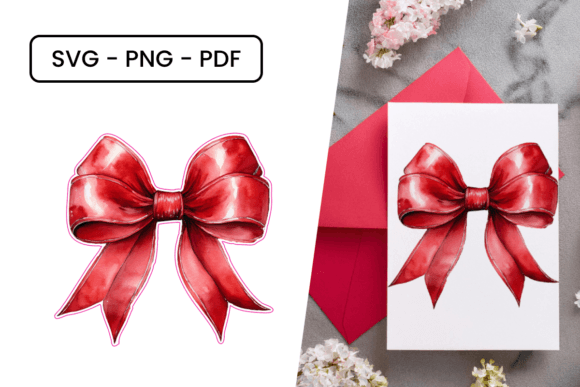
This illustration style utilizes advanced vector masking and high-resolution texture mapping to simulate the bleed, granulation, and transparency of real watercolor paint while maintaining the structural benefits of an SVG. The result is a red ribbon—or any colored element—that appears hand-painted with soft edges and varying opacity, yet can be resized from a business card to a billboard without losing a single detail. This duality makes it particularly valuable for professionals who must deliver assets across multiple mediums, from digital screens to large-format printing.
Comparing Formats: SVG vs. PNG vs. AI
When selecting assets for a project involving printed materials or apparel, designers often weigh the pros and cons of different file types. A comprehensive evaluation usually involves comparing the Watercolor Ribbon Illustration SVG against its counterparts: high-resolution PNGs and native Adobe Illustrator (AI) files.
- Scalability and Resolution: The primary advantage of the SVG format is its resolution independence. Whether you are printing a small tag for a gift bag or a large banner for a holiday sale, the SVG ensures crisp edges. In contrast, even a high-resolution PNG file with a transparent background at 2000px has a hard limit. If a client requests an enlargement beyond the original pixel dimensions, the PNG will degrade, whereas the SVG remains perfect.
- Editability and Workflow: While the SVG offers great flexibility, the included AI file often provides deeper control for users with Adobe Creative Cloud subscriptions. The AI file allows for the manipulation of individual anchor points and complex layer structures that might be flattened in an SVG export. However, for users utilizing cutting machines (like those used in apparel customization) or web-based design tools, the SVG with included cut lines is often the superior choice due to its universal compatibility.
- Texture Fidelity: High-resolution PNGs sometimes render watercolor textures more accurately out of the box because they are essentially photographs of paintings. However, modern SVG workflows have narrowed this gap significantly. By embedding high-res texture maps within the vector code, the Watercolor Ribbon Illustration SVG achieves a visual fidelity that satisfies most professional print requirements while offering the logistical benefits of a vector.
Ideal Use Cases and Application Scenarios
Determining whether this specific asset style fits your project requires analyzing the end-use environment. The Watercolor Ribbon Illustration SVG excels in scenarios where a blend of elegance and festivity is required.
Holiday and Celebration Branding
For holidays such as St. Valentine's Day and Christmas, the emotional tone of the design is paramount. A red ribbon rendered in watercolor evokes warmth, tradition, and a handmade feel that flat, corporate vectors often miss. This makes it an ideal choice for:
- Invitations and Cards: The soft edges of the watercolor style complement typography well, allowing text to sit comfortably over or beside the ribbon without visual conflict.
- Packaging Design: When applied to boxes or bags, the texture adds a premium tactile perception, even though it is visually printed.
- Apparel and Merchandise: With cut lines included in the SVG file, these illustrations are ready for heat transfer vinyl (HTV) or sublimation printing. The ability to separate the ribbon from the background digitally streamlines the production process for custom t-shirts or tote bags.
Digital and Web Integration
Beyond print, these assets are increasingly relevant for web design. Because SVG files are code-based, they load quickly and remain sharp on high-DPI retina displays. Using a watercolor ribbon as a decorative element on a landing page or in an email newsletter can add a seasonal touch without increasing load times significantly, provided the file is optimized.
Tradeoffs and Limitations to Consider
While the Watercolor Ribbon Illustration SVG is a powerful tool, it is not a universal solution for every design challenge. A balanced assessment requires acknowledging its limitations.
Complexity in Editing: To achieve the watercolor look within a vector format, the file structure can become complex. It may involve numerous clipping masks and gradient meshes. For a novice designer, opening the SVG in a basic editor might reveal a complicated layer structure that is difficult to recolor or modify compared to a simple solid-color shape. If your project requires changing the red ribbon to a specific brand color instantly, a flat vector might be more efficient than a textured watercolor simulation.
Print Production Constraints: Although suitable for most printed materials, extremely fine watercolor details can sometimes get lost in low-quality offset printing or on rough paper stocks. Designers should always request a proof when using detailed textured vectors for mass production. Furthermore, while the 2000px PNG included in the package is sufficient for many uses, it may not meet the strict 300 DPI requirements for very large format prints if the vector option is unavailable or unusable in a specific workflow.
Making the Right Choice for Your Project
Selecting the appropriate resource ultimately depends on your specific workflow and the needs of your client. If you are a creator focusing on rapid prototyping for social media or small-batch crafts using cutting machines, the Watercolor Ribbon Illustration SVG with pre-defined cut lines is likely the most efficient path. It removes the need for manual tracing and ensures clean cuts.
However, if you are an art director overseeing a high-end branding campaign where every shade of red must be perfectly matched to a Pantone guide, you might lean towards the AI file to manually adjust the vector nodes and color values, or even commission a custom painting. The included high-resolution PNG serves as an excellent middle ground for quick mockups or for designers who do not use vector software but still require a transparent background.
In conclusion, the value of a Watercolor Ribbon Illustration SVG lies in its hybrid nature. It offers the emotional resonance of traditional art with the technical robustness of modern digital formats. By understanding the differences between the SVG, AI, and PNG options provided in such packages, designers can make informed decisions that enhance their creative output while respecting the constraints of their production timeline and budget. Whether for a romantic Valentine's card or a festive Christmas label, this asset type provides a sophisticated foundation for visual storytelling.