Strategic Deployment of the Cross Multilayer Decorative Template for Precision Fabrication
In the realm of digital fabrication, the difference between a generic output and a high-value product often lies in the sophistication of the source file. The Cross Multilayer Decorative Template represents more than just a collection of vector lines; it is a strategic asset for creators, small business owners, and hobbyists looking to maximize the efficiency and aesthetic appeal of their laser cutting and CNC routing operations. By leveraging a pre-engineered multilayer layout, operators can bypass the time-consuming phase of structural design and focus immediately on material selection, finishing techniques, and market positioning. This approach allows for the rapid production of distinct interior decorations and household items that possess both elegance and structural integrity.
The core value of utilizing a CROSS Digital multilayer layout lies in its adaptability across various industries and use cases. Whether you are a freelancer fulfilling a custom order for a religious institution, an educator demonstrating geometric principles through physical models, or an entrepreneur building a catalog of home decor items, the template serves as a reliable foundation. The file is specially prepared for laser cut, CNC router machine, and other cutting machines, ensuring that the paths are optimized for clean cuts and efficient assembly. This preparation reduces machine runtime and minimizes material waste, two critical factors in maintaining healthy profit margins and operational sustainability.
Operational Efficiency and Material Strategy
When integrating the Cross Multilayer Decorative Template into your workflow, the first strategic decision involves material selection. The recommended materials—Plywood, MDF, Acrylic, Plexiglas, Metal, Cardboard, and Paper—offer a wide spectrum of possibilities for branding and functional application. However, the choice of material should not be arbitrary; it must align with the intended environment of the finished product. For instance, a cross designed for a permanent church installation demands the durability of hardwood plywood or metal, whereas a temporary event decoration might benefit from the cost-effectiveness of MDF or cardboard.
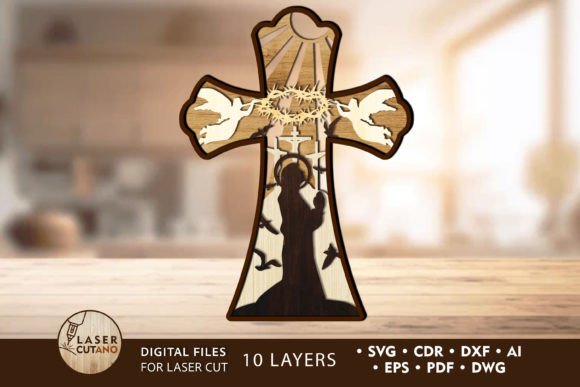
The template specifies a recommended material thickness for wood between 3 mm and 6 mm (approximately 1/8 inch to 1/4 inch). Adhering to these specifications is crucial for the structural logic of the multilayer design. The concept relies on stacking ten distinct layers to create depth and a self-standing capability. If the material is too thin, the final product may lack the necessary stability to stand on a table without additional support. Conversely, using material that is too thick without adjusting the file dimensions can result in alignment issues during the gluing process. A thoughtful operator will test cuts on scrap material to verify kerf width and layer fit before committing to a full production run.
Furthermore, the ability to increase the size of the design offers scalability for different projects. You might scale up the religious laser cut cross svg file to create a large wall hanging or scale it down for intricate jewelry or keychains. However, caution is required when reducing the design. As the overall dimensions shrink, the thin elements within the vector paths may become fragile or impossible to cut cleanly depending on the machine's precision and the material's grain. Strategic planning dictates that any scaling operation must be accompanied by a review of the smallest details to ensure they remain viable for fabrication.
Enhancing Aesthetic Value Through Finishing Protocols
The true potential of the Cross Multilayer Decorative Template is unlocked not during the cutting phase, but during the finishing and assembly stages. The multilayer nature of the model creates shadows and depth that single-layer cuts cannot achieve. To maximize this visual impact, the strategic advice is to paint before gluing. Attempting to paint the assembled layers often results in missed spots, uneven coverage in the crevices, and a generally amateurish finish. By painting each of the ten layers individually prior to assembly, you ensure a professional, cohesive look that highlights the geometric complexity of the design.
This step also opens avenues for creative differentiation. A creator might choose to paint alternating layers in contrasting colors to emphasize the depth, or use a gradient effect that transitions from dark to light, adding a modern twist to a traditional christian laser cut cross shape. For corporate clients or specific branding initiatives, the layers could be painted in company colors, transforming a standard religious symbol into a customized corporate gift or award. The versatility of the laser cut file christian laser cut cross format allows for such customization without altering the underlying structural geometry.
Assembly requires patience and precision. Since each layer of the multilayer model is glued, the alignment must be perfect to maintain the symmetry of the cross. Using a jig or a flat surface with alignment pins can significantly speed up this process while ensuring consistency across multiple units. For entrepreneurs producing batches for retail, optimizing this assembly line process is essential for scaling operations without sacrificing quality.
Technical Compatibility and File Management
From a technical operations standpoint, the versatility of the file formats provided ensures compatibility with nearly any digital fabrication ecosystem. Upon payment, the user receives a .zip file containing the design in .AI, .SVG, .DXF, .DWG, .CDR, .EPS, and .PDF formats. This breadth of options eliminates the friction of file conversion, which can often introduce errors or scale discrepancies. Whether your workshop runs on Adobe Illustrator, CorelDRAW, AutoCAD, or open-source alternatives like Inkscape, there is a native or near-native format available to streamline your workflow.
It is imperative to remember to unzip the folder before using files. Attempting to import directly from a compressed archive can lead to software errors or corrupted paths. Once extracted, users should inspect the vector paths for any open nodes or overlapping lines that might have occurred during the compression or extraction process, although these files are generally prepared to be machine-ready. The cnc cross dxf and religious svg files are optimized to minimize travel time for the laser head or router bit, contributing to faster production cycles and reduced wear on equipment.
Risk Mitigation and Intentional Usage
While the Cross Multilayer Decorative Template offers significant advantages, relying on it without clear goals or context can lead to suboptimal outcomes. A common pitfall is the "random creation" syndrome, where makers produce items without a defined audience or purpose. This often results in inventory stagnation and wasted resources. To avoid this, approach the use of the cross laser cut file with a specific strategy. Are you creating this for a specific holiday season? Is it part of a larger collection of geometric home decor? Does it serve a specific function, such as a bookend or a memorial piece?
Another risk involves ignoring the limitations of the chosen material. While the template supports metal and acrylic, the joining method (gluing) may need adjustment compared to wood. Acrylic, for example, may require solvent welding rather than standard wood glue to achieve a seamless bond. Failing to adapt the assembly technique to the material can result in products that fall apart or look disjointed. Additionally, when working with darker woods or metals, the visual depth created by the layers might be less apparent unless lighting is strategically used in the display environment.
Strategic usage also means considering the end-user experience. If the product is intended for households with children or pets, the sturdiness of the bond and the non-toxicity of the paints become paramount. The CROSS Bundle multilayer layout produces a finished product size of 9 x 12 inches, which is substantial enough to be a focal point but small enough to fit on most shelves. However, if the target market prefers minimalist aesthetics, the ten-layer depth might be too ornate. In such cases, the creator might choose to use fewer layers, modifying the file to suit specific taste profiles, thereby demonstrating agility and customer-centric thinking.
Long-Term Value and Creative Positioning
Incorporating the Cross Multilayer Decorative Template into your portfolio is a move toward long-term value creation. It allows for the development of a signature style based on precision layering and depth. Over time, as you master the finishing and assembly nuances of this specific design, you can expand into complex multilayer projects, using this cross as a foundational learning tool. The skills acquired—material testing, color theory application in layered contexts, and efficient batch assembly—are transferable to countless other designs.
For educators, this template serves as an excellent vehicle for teaching spatial reasoning and the relationship between 2D vectors and 3D objects. Students can engage with the religious laser cut cross svg file to understand how stacking flat planes creates volume, a fundamental concept in architecture and engineering. For marketers and bloggers, documenting the process of transforming a digital file into a tangible, high-quality object provides compelling content that resonates with audiences interested in DIY, craftsmanship, and faith-based art.
Ultimately, the decision to use a laser cut file of this caliber should be driven by a desire for quality and efficiency. By treating the template not merely as a download but as a component of a broader production strategy, you elevate the perceived value of your output. Whether the goal is to enhance a sacred space, create a unique gift, or build a scalable product line, the Cross Multilayer Decorative Template provides the structural and aesthetic framework necessary to achieve professional results. The key lies in intentional planning, meticulous execution, and a commitment to refining the details that distinguish a commodity from a crafted masterpiece.